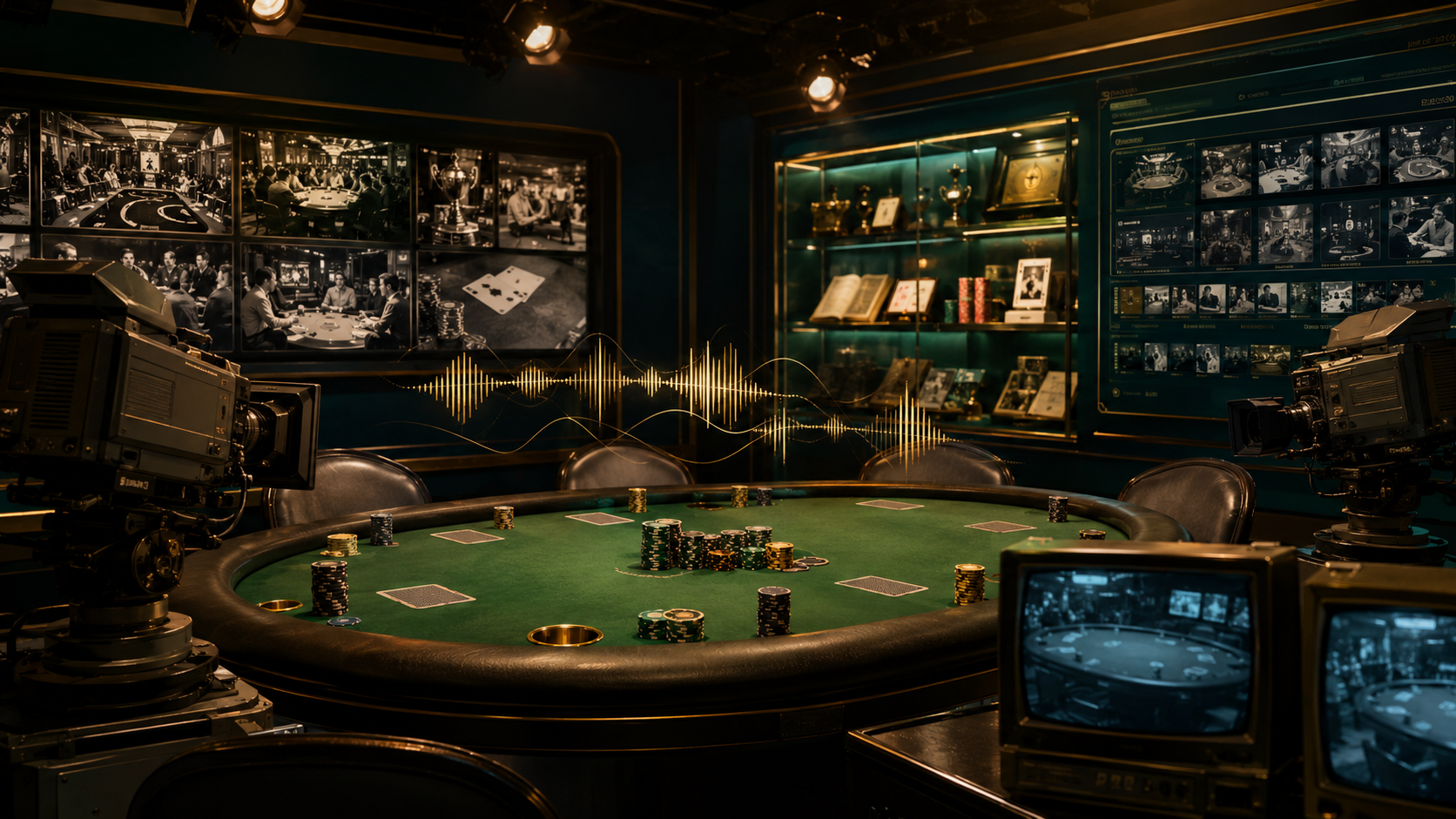
The Lost Art of Table Talk: Why Poker Conversations Used to Matter
Old poker TV had something modern poker content often misses.
Conversation.
Not just commentary. Not just a pro explaining solver outputs after the hand. Actual table talk. Players needling each other. Asking questions. Going quiet at the wrong time. Laughing too much. Talking through a decision. Pretending to be relaxed while holding a monster. Pretending to be strong while holding absolute garbage.
It made poker feel human.
Before every hand became a range chart and every bet size became a solver-approved decimal, live poker had another layer of drama: the people.
The chips mattered. The cards mattered. The math mattered.
But so did the silence before a call.
That is why table talk used to be such a big part of poker broadcasts. It gave viewers something charts never could: personality under pressure.
Why Old Poker TV Felt More Human
Old poker broadcasts were slower, but that was part of the charm.
You had time to watch the table breathe. A player stacked chips. Another stared at the board. Someone cracked a joke. Someone answered too quickly. Someone went silent after talking all orbit.
That stuff mattered because poker is not just a card game. It is a decision game played by people trying to hide their decisions from other people.
Modern poker analysis is sharper in many ways. Solvers, databases, hand histories, equity tools, and training platforms have made players much better. Nobody serious wants to go back to the days of guessing everything by “feel” alone.
But old poker TV captured something different.
It showed how players handled pressure in real time.
And pressure is where people get interesting.
Table Talk as Information Warfare
Table talk is not just chatter.
At its best, it is information warfare.
A player might ask a question to see how quickly you answer. They might joke to measure your comfort. They might describe the hand out loud to test your reaction. They might say, “You want a call?” while watching your breathing, posture, chip handling, or eye movement.
Sometimes the words matter.
Often, the timing matters more.
A confident instant answer can look suspicious. A delayed joke can reveal nerves. A player who normally talks nonstop and suddenly freezes may be telling you something. A quiet player who suddenly starts performing might also be telling you something.
Poker table talk is rarely about the sentence itself.
It is about the mismatch between the sentence and the situation.
That is where the clues live.
Silence as a Weapon
Table talk gets the attention, but silence can be just as powerful.
Some players use silence to avoid leaking information. They say nothing because they know every word can become evidence. That is smart.
Other players use silence to apply pressure. They make the opponent sit with the decision. They let the room get heavy. They force the bettor to wonder whether the quiet means strength, weakness, patience, or nothing at all.
Silence can also expose patterns.
If a player always chats with medium-strength hands but goes silent with monsters, that is useful. If they suddenly stop talking when bluffing, also useful. If they talk only when relaxed, that can become a tell.
The key is not assuming silence means one thing.
The key is comparing it to the player’s normal behavior.
A quiet person being quiet means little.
A loud person becoming quiet can mean plenty.
Speech Play vs Nonsense Chatter
There is a difference between speech play and noise.
Speech play has a purpose. It is designed to extract information, create doubt, project confidence, or manipulate perception.
Nonsense chatter is just someone filling the air because they are uncomfortable.
Good speech play is controlled. It asks subtle questions. It creates pressure without looking desperate. It gives the opponent room to reveal something.
Bad speech play is obvious. It sounds like a bad actor trying to sell a bluff to the back row.
Examples of weak chatter:
• “I guess you have it.”
• “I don’t know, man, I might call.”
• “You look nervous.”
• “I knew you were bluffing.”
• “If I had it, would I talk this much?”
That last one is usually said by someone who absolutely should stop talking.
Strong players understand that speech play is not about being loud. It is about being useful.
Sometimes one calm question is worth more than a full monologue.
Why Online Poker Changed the Psychology
Online poker removed most of the physical table.
No eye contact. No chip handling. No voice. No posture. No awkward silence after someone asks a direct question. No player doing weird theatrical sighs before making the obvious call.
Instead, online poker created a different kind of information.
Timing tells. Bet sizing. Auto-actions. Chat box behavior. Multi-tabling patterns. Population tendencies. HUD stats. Session rhythms.
The psychology did not disappear.
It moved.
A fast check can mean something. A delayed river bet can mean something. A player who snap-calls preflop but tanks river decisions may have a pattern. A recreational player typing in chat during big pots may reveal tilt or confidence.
Still, it is not the same.
Live table talk gives poker texture. It makes each player feel like a person, not just a node in a database.
That is why old broadcasts still feel alive.
You are watching poker, but you are also watching humans try very hard not to be readable.
What Modern Players Can Still Learn
Modern players should not ignore table talk just because solvers exist.
Solvers are excellent for understanding strategy. They teach ranges, frequencies, bet sizing, blockers, board texture, and equilibrium logic.
But live poker is not played by perfect machines.
It is played by tired people, tilted people, wealthy amateurs, overconfident pros, quiet grinders, nervous qualifiers, table captains, and players who say “nice hand” like they are filing a complaint.
That means live reads still matter, especially when they support the strategic picture.
Modern players can learn:
• Watch baseline behavior before trusting tells
• Compare speech patterns across hands
• Do not overvalue one comment
• Use table talk to gather information, not show off
• Stay consistent when you speak
• Avoid giving away timing tells
• Let silence work when words would leak too much
Table talk is not a replacement for good strategy.
It is an extra layer.
And extra layers matter in close spots.
The Best Talkers Were Really Good Listeners
The players who used table talk well were not always the loudest.
They were the best listeners.
They noticed how opponents answered. They noticed whether jokes landed naturally or felt forced. They noticed who relaxed after betting and who tightened up. They noticed when someone gave a speech that sounded prepared.
Good live players collect small bits of behavior all session.
Then, in a big pot, those details help shape a decision.
Not alone. You still need pot odds, ranges, board texture, and stack depth.
But if the strategic decision is close, human information can tip the scale.
That is what old poker TV showed so well.
Every table had its own little ecosystem. Every player brought a style. The drama came from watching those styles collide.
The Risk of Talking Too Much
Of course, table talk cuts both ways.
If you talk, you can gather information.
You can also give it away.
Some players think they are clever because they keep speaking during big hands. In reality, they become easier to read. They repeat phrases. They perform differently with strong and weak hands. They answer questions too quickly. They laugh when nervous. They go quiet when trapping.
The safest approach for many players is simple:
Say less in big pots.
If you do talk, keep your tone and timing consistent. Do not suddenly become a comedian when bluffing or a statue when value betting. Opponents notice that stuff.
Poker players are nosy by profession.
Give them less to work with.
Why Broadcasts Loved Table Talk
From a TV perspective, table talk was gold.
It gave commentators something to discuss. It gave viewers insight into personalities. It turned silent math into visible conflict.
A player asking, “Will you show if I fold?” creates a mini-drama.
The cards may already be decided, but the decision is not.
That is why table talk helped poker become watchable for broader audiences. It made the game feel like a psychological duel, not just people moving chips around a green table.
The best broadcasts understood this.
They let tension breathe. They showed the stare-down. They kept the camera on the player thinking, not just the pot size.
Modern poker content can learn from that.
The hand is not only the result.
The hand is the conversation before the result.
Final Thought: Poker Is Still a People Game
Poker has changed.
Solvers matter. Online databases matter. Game theory matters. Training tools matter. Modern players are technically better than ever.
But live poker is still a people game.
Cards do not talk. People do.
Sometimes they talk with words. Sometimes with silence. Sometimes with timing, posture, chip movement, jokes, hesitation, or a weirdly calm “good luck” before the river card.
That human layer is what made old poker broadcasts so compelling.
Table talk was not always strategic. Sometimes it was nonsense. Sometimes it was comedy. Sometimes it was ego in a hoodie.
But at its best, it revealed the real game underneath the game.
Not just what cards a player had.
What pressure did to them.
And that is still worth watching.